
Rep. John Ley says Washington doesn’t have a revenue problem; it has a spending addiction
Governor Bob Ferguson proudly declared himself a “hands-on guy” when it comes to the budget. That hands-on approach has produced the largest spending packages in Washington state history — first in May 2025, then an even bigger one the following year. Under one-party Democratic rule in Olympia, restraint has become a dirty word and fiscal discipline a distant memory.
Majority Democrats have rammed through the largest tax hikes in state history, two years running. The 2025 budget piled on $9.5 billion in new General Fund taxes plus $3.2 billion in transportation taxes. A year later came another nearly $4.5 billion hit. On top of that was the $4 billion theft of law enforcement and fire fighter pension funds.
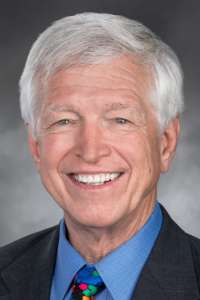
Since 2001, the state operating budget has exploded by 230 percent. Even the state’s own Office of Financial Management Director K.D. Chapman-See warned last month that revenue forecasts won’t cover current programs, let alone the expansions Democrats crave — despite all those new taxes. Since 2021, the state has increased appropriations for new policy by a net of $15.5 billion.
After a grueling 24.5-hour legislative battle, House Democrats pushed through an income tax. Beginning in 2029, every Washingtonian will file a state tax return for 2028 income. Never mind that courts have struck down an income tax eleven times as unconstitutional. Party leaders simply kept working their long-term plan to seize more of your earnings.
They sell it with the usual emotional script: “It’s for the schools.” “It’s for the children.” “It’s for the poor.” Yet the fine print in the bill Governor Ferguson signed puts the money into the unrestricted General Fund, where well-connected politicians can redirect it however they please in future sessions. This isn’t compassion; it’s a power grab dressed up as charity.
The results are predictable. Businesses and high earners are voting with their feet. Starbucks, Janicki Industries, and countless small companies are relocating. Clark County’s Ken Fisher moved his headquarters to Texas after the capital gains tax.
Jeff Bezos left for Florida to escape the 9.9 percent capital gains tax, taking hundreds of millions in potential revenue with him. Starbucks founder Howard Schultz headed to Florida in response to the new income tax. Seattle startup Moment’s CEO Marc Barros is taking his company to Wyoming. Seattle Mayor Katie Wilson’s dismissive “bye” to departing businesses captures the left’s arrogant indifference perfectly.
An Association of Washington Business survey found 44 percent of business leaders considering leaving the state, with 64 percent citing the crushing tax burden as their top concern. No wonder. Moody’s and Fitch downgraded Washington’s credit outlook from stable to negative in April. Former Democratic Governors Christine Gregoire and Gary Locke have publicly acknowledged the state’s spending problem and lack of fiscal discipline.
The Heritage Foundation recently highlighted alarming numbers from the state treasurer: reserves sit at a dangerously low 8 percent — just 22 days of operating budget, the worst in the nation. Per capita debt exceeds $3,500, more than double the national median.
The state workforce has ballooned from roughly 125,892 full-time equivalents in 2020 to 138,109 today. At $100,000 average compensation, simply returning to 2020 staffing levels would save about $1.2 billion. The self-insurance fund hemorrhages red ink to the tune of $1.7 billion, including $537 million last year alone for government misconduct — much of it from the Department of Children, Youth and Families.
Collective bargaining deals and raises added nearly $2 billion to the 2025 budget. With new union negotiations looming, Governor Ferguson must finally hold the line instead of signing blank checks with taxpayer dollars.
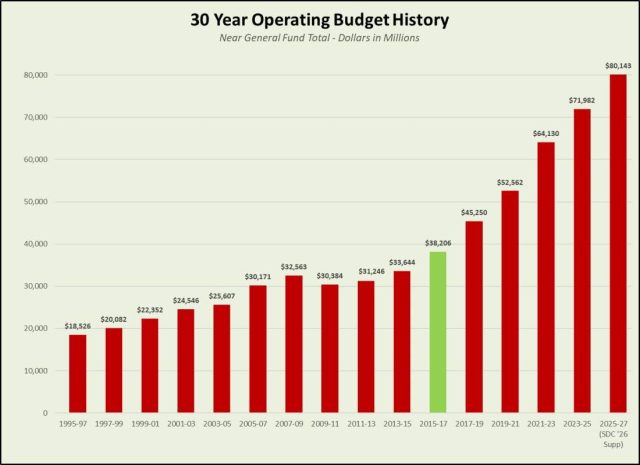
Washington Senate Republicans distributed this chart in 2025 to spotlight the last time they helped write the state budget, in 2015-17. The state’s uncontrolled explosion of spending began a decade ago. Graphic courtesy Senate Republicans
Contrast this disaster with fiscally responsible states. Idaho has delivered roughly $4 billion in tax cuts since 2021 through phased income tax reductions. Florida, under Governor Ron DeSantis, has enacted nearly $6.7 billion in tax relief since 2019 while maintaining strong surpluses. He recently vetoed $1.6 billion in spending, increasing reserves to $18 billion. Low taxes, spending restraint, and economic growth — the conservative formula works where it’s tried.
Governor Ferguson and Olympia Democrats: How many more warning signs do you need? Businesses fleeing, credit downgrades, depleted reserves, exploding debt, and a bloated bureaucracy are screaming for course correction. As chief executive, the governor could immediately cut non-essential spending — including the roughly 300 new Department of Revenue positions hired to enforce an unconstitutional income tax. Please demand real reform from agencies bleeding red ink through lawsuits and mismanagement.
Washington doesn’t have a revenue problem; it has a spending addiction. It’s time to follow the example of fiscally responsible states like Idaho and Florida. Cut taxes, slash waste, reduce the size of government, and restore accountability. Taxpayers have been patient long enough. The warning signs are flashing red — ignore them at our state’s peril.